Answering the common buyer need for safe, portable fuel on boats, these gas caddies are designed to move fuel efficiently while minimizing spills. They’re best for boaters who need to refuel in docks, marinas, or while on the water, as well as for land vehicles that require reliable refueling on rugged terrain. The following five models stand out for their capacity, transfer options, and durability, making them suitable for motorboats, ATVs, lawn equipment, and small ships. The table below compares the top five selected options at a glance.
| Product | Capacity | Best For | Key Advantage |
|---|---|---|---|
| VEVOR Fuel Caddy | 15 Gallon | Boaters with varying refuel needs | Manual pump option and durable HDPE body |
| Scepter Duramax Flo ’N Go 14 Gallon | 14 Gallon | Marina refuels and lawn/boat maintenance | Two fueling modes; rugged wheels |
| PAMBEE 15 Gallon Gas Can | 15 Gallon | Frequent fueling on boats and trailers | Siphon and gravity modes; long hose |
| Garvee 15 Gallon Gas Caddy | 15 Gallon | Rugged outdoor use | Dual shut-off valves; ergonomic pump |
| GAOMON 15 Gallon Fuel Caddy | 15 Gallon | Marine and auto use | Low spillage design; 2-way siphon pump |
VEVOR Fuel Caddy, 15 Gallon

The VEVOR unit combines a large 15-gallon capacity with a manual pump option, useful when power is unavailable. Its HDPE body resists corrosion, scratches, and sun exposure, helping it hold shape and prevent leaks over long-term outdoor use. Best for boaters who need to refuel multiple tools or engines between top-ups, or those who operate in remote locations where electricity isn’t accessible. Caution: ensure proper venting and avoid overfilling to minimize spills when transferring near water.
Scepter Flo ’N Go 14 Gallon Gas Caddy

The Scepter Flo ’N Go offers two fueling modes—gravity flow and manual siphon—making it versatile for elevated fills or when the caddy sits on the ground. Its 14-gallon capacity suits boats and larger outdoor equipment, while six-inch wheels and a rugged build enable maneuvering across docks or uneven terrain. Best for users who value a straightforward siphon option and reliable transfer. Limitation: flow rate in gravity mode depends on height and positioning during use, so plan refueling height accordingly.
PAMBEE 15 Gallon Gas Can
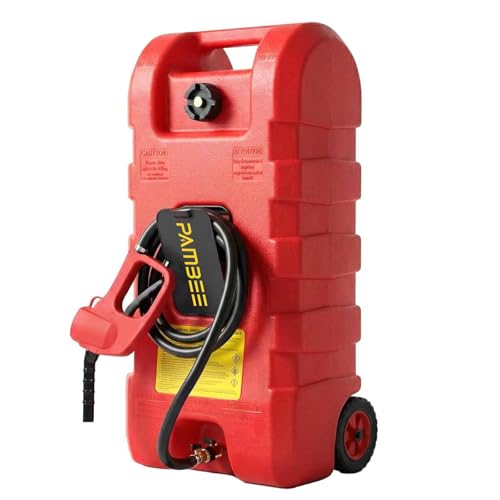
The PAMBEE model emphasizes high capacity with a 15-gallon tank and a 10-foot hose, making it ideal for boats, ATVs, or larger equipment setups. It supports both siphon and gravity-driven refueling, and a 3 GPM siphon flow enables faster transfers when gravity isn’t practical. Best for multi-vehicle refueling on job sites or marinas. Caution: siphon speed depends on how quickly you press, so expect variation in flow with manual control.
Garvee 15 Gallon Gas Caddy

The Garvee gas caddy focuses on heavy-duty durability with industrial-grade HDPE construction that resists corrosion and UV exposure. Its dual shut-off valves and vapor-tight seals minimize spills, a key safety feature for boating and home shop use. An ergonomic manual pump and 360° rotating nozzle support precise, mess-free transfers. Best for rugged environments; caution: the heavier build may require more effort to maneuver on very soft ground.
Caquerol 16 Gallon Gas Caddy

Caquerol expands capacity slightly to 16 gallons and uses a robust pump system with a 2.3/3.7 GPM flow range. It includes a 10-foot hose and wheels for mobility, designed for cars, boats, ATVs, and lawn gear. The dual-direction pump and safe venting help prevent spills during transfer. Choose this if you need a larger reservoir while maintaining control over flow. Limitation: higher capacity adds weight, which can affect ease of transport on very uneven surfaces.
Buying Guide: Key Purchase Considerations
What capacity do you need? If your boat routinely refuels multiple devices, a 15–16 gallon caddy offers fewer fill stops. For smaller boats or light-duty tasks, 12–14 gallons may suffice. How will you transfer fuel? Pick between gravity flow, siphon/pump, or dual-mode options depending on where you refuel and your pumping availability. What materials and safety features matter? Look for high-density polyethylene to resist corrosion and a secure seal system to minimize spills. How portable should it be? Wheels, handles, and weight distribution affect maneuverability on docks and rough terrain. Finally, consider hose length and compatibility with your fuel type (gasoline, diesel, or both) and any local safety regulations.
Frequently Asked Questions
- What fuel capacities are typical for marine gas caddies? Most commonly 14–15 gallons, with some models offering up to 16 gallons.
- Is a siphon pump safer than a hand pump for boats? Siphon pumps reduce lifting, but both should be used with care to prevent spills; choose one that matches your refueling workflow.
- Can you use these caddies for diesel? Many models specify diesel compatibility, but always verify material compatibility and seals for diesel fuel.
- Do these caddies meet marina safety standards? Look for vented caps, spill-proof hoses, and dual shut-off valves to minimize risk in marine environments.
- How do I prevent fuel spills on a boat? Use properly sealed hoses, keep the caddy on stable ground, and pump slowly near the tank fill point to avoid overflows.
- Are these caddies easy to store on a boat? Models with compact dimensions and built-in hose storage are easier to stow in tight spaces when not in use.